Why Read Top of Minisicus in Burete

During lab experiments particularly in chemical science, we are always told to take a reading at bottom of the meniscus for colourless liquids and the upper meniscus of coloured liquids. A pupil while performing various experiments sometimes gets confused which meniscus to utilise when. Without knowing the reason why it is mandated thus, it sometimes becomes very disruptive.
Before we begin our discussions on this, let us understand what we mean by the Meniscus.
The free surface of a liquid called meniscus, assumes a flat, convex or concave shape, depending on the solid and liquid surface. The meniscus is the bend in the upper surface of a liquid close to the surface of the container or another object, caused by surface tension. Information technology can either exist convex or concave, depending on the liquid and the surface.
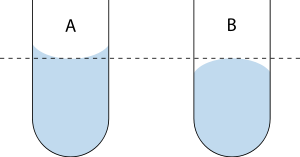 A convex meniscus occurs when the particles in the liquid take a stronger attraction to each other (cohesion) than to the fabric of the container (adhesion). A convex meniscus occurs, for example, betwixt Mercury and glass in barometers and thermometers. Conversely, a concave meniscus occurs when the particles of the liquid are more strongly attracted to the container than to each other, causing the liquid to climb the walls of the container. This occurs between water and glass.
In the above effigy,
A: The lesser of a concave meniscus.
B: The peak of a convex meniscus.
Now coming back to the original question, why should we record the reading at the lower meniscus of colourless liquid and at the upper meniscus of coloured liquid?
In the case of colourless liquid, it is easy to notice the phase boundary, whether it is convex or concave hence in the colourless liquid lower meniscus may be considered. A meniscus is the curvature of the surface of the water. Water "sticks" to the walls of the graduated cylinder, merely only on the sides and not the middle. When students look at the surface, the water level is non straight. Measurement should be therefore done at the lowest point.
However, in the case of coloured liquids observing this phase boundary (spatial interface, called a stage purlieus) is not possible, hence only the upper meniscus is considered.
Why is it necessary to read the meniscus at eye level?
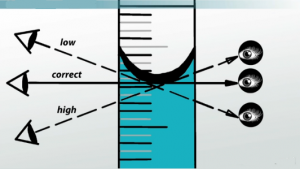 During the measurements, students are supposed to detect or note the meniscus reading from eye level because viewing from either in a higher place or below the eye level can return the reading inaccurate. Hence, in guild to become an accurate reading, students need to read the meniscus at eye level.
When y'all perform an experiment in the lab, information technology is always better to know the fact and reason of every experiment procedure that is adopted.

Rahul Kumar
Rahul Kumar is a member of Zigya'southward Science aqueduct and oversees Chemistry as a discipline. He has completed his Masters of Science in Chemical science from Punjab Academy. Rahul is e'er full of ideas and brings with him, the enthusiasm and charm to go people involved in them. Follow his work at www.zigya.com
Published in Chemistry
Source: https://www.zigya.com/blog/meniscus/

Posting Komentar untuk "Why Read Top of Minisicus in Burete"